
Kindergarten Readiness Checklist
Starting kindergarten is a big step, and parents often wonder whether their child is “ready”. This checklist covers the everyday skills teachers commonly find helpful — from opening a lunchbox to taking turns and recognising letters in their name — and suggests playful ways to practise anything still developing. Children develop at different rates; it’s a guide for conversation and practice, not a test.
- Free to use
- No sign-up
- Runs in your browser
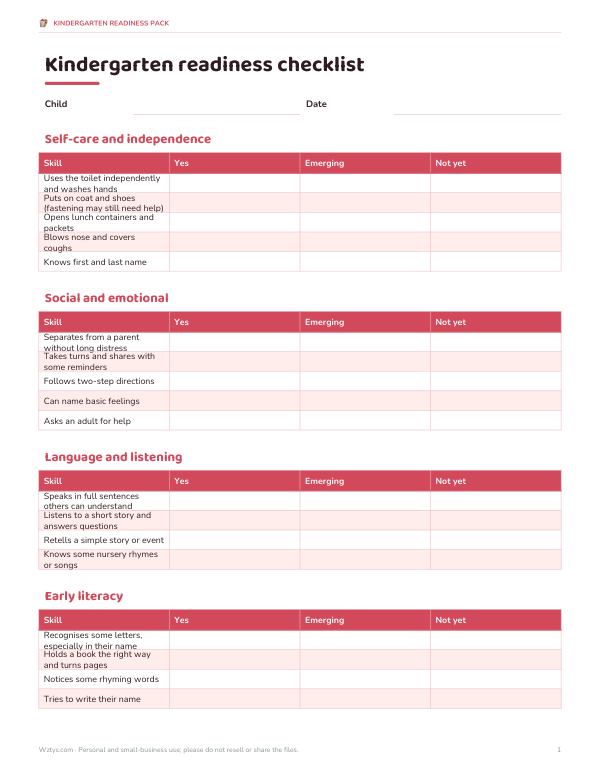
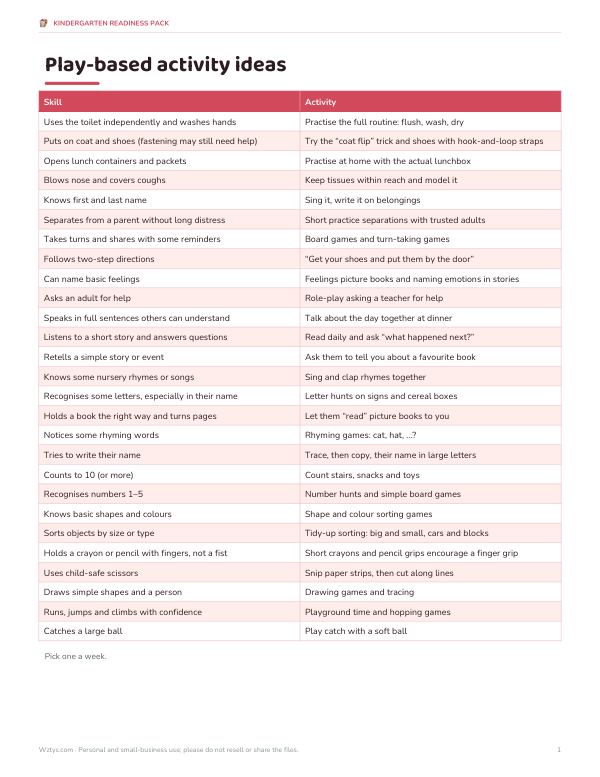
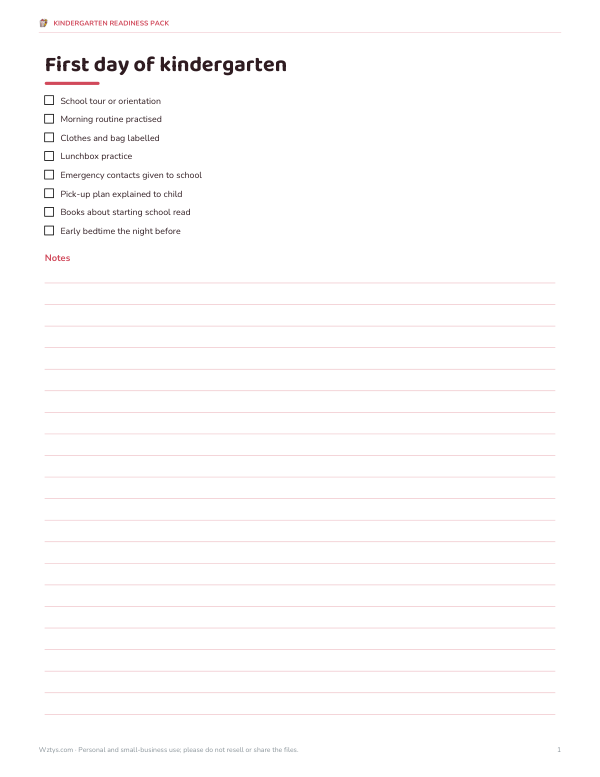
Kindergarten readiness checklist
Kindergarten Readiness Pack
Printable kindergarten readiness checklist, 30 play-based activity cards, a first-day preparation checklist, name tracing pages and an all-about-me page for the teacher.
- Readiness checklist (PDF/DOCX)
- Activity cards (PDF)
- First day checklist (PDF/DOCX)
- Name tracing (PDF)
- All about me (PDF/DOCX)
Formats: PDF, DOCX. Instant download after payment (link valid 72 hours, up to 5 downloads). AI-assisted: the templates were drafted with AI help and reviewed and laid out before publishing.
$5.00 USD, one-time 5 files · about $1.00 each
- Instant download
- 7-day refund
- Secure checkout by Stripe
7-day money-back guarantee. Full refund within 7 days of purchase, even after you download.
Free sample: Activity Cards (PDF, 62 KB)
Full refund within 7 days — see the refund policy and license.
Free printables
Single sheets you can print right now, no sign-up. The full pack adds every sheet in one download plus the editable files.
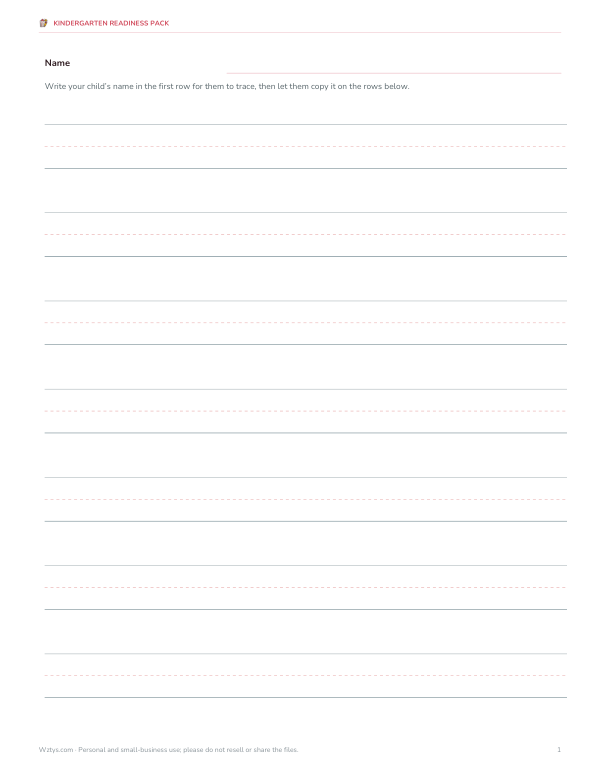 Name Tracing Printable PDF
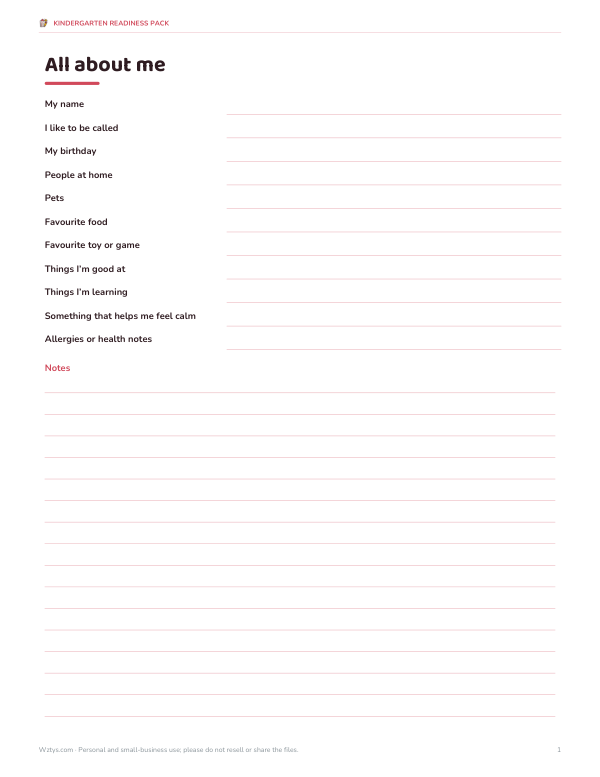 Printable All About Me Sheet
What the checklist covers
| Area | Skills | Examples |
|---|---|---|
| Self-care and independence | 5 | Uses the toilet independently and washes hands; Puts on coat and shoes (fastening may still need help) |
| Social and emotional | 5 | Separates from a parent without long distress; Takes turns and shares with some reminders |
| Language and listening | 4 | Speaks in full sentences others can understand; Listens to a short story and answers questions |
| Early literacy | 4 | Recognises some letters, especially in their name; Holds a book the right way and turns pages |
| Early math | 4 | Counts to 10 (or more); Recognises numbers 1–5 |
| Fine and gross motor | 5 | Holds a crayon or pencil with fingers, not a fist; Uses child-safe scissors |
Altogether 27 everyday skills. Mark each one Yes, Emerging (sometimes, or with help) or Not yet. The summary lists a play-based activity for every item that’s still developing.
Readiness is broad
Kindergarten teachers often say the most helpful skills aren’t academic: being able to manage the bathroom, open lunch, follow simple routines, ask for help and get along with other children. Recognising letters and counting help too, but schools teach these skills — many children start knowing only a few letters. Readiness also depends on the school: programmes, cut-off dates and expectations differ between districts and countries.
Worked example
A parent goes through the checklist in May for a September start. Most items are “Yes”, but opening lunch containers, cutting with scissors and writing their name are “Emerging”, and separating at drop-off is “Not yet”. The summary suggests practising with the actual lunchbox, snipping paper strips, tracing their name, and short practice separations with a grandparent. With about 15 weeks to go, the family picks one activity a week and prints the list to share with the new teacher at the welcome meeting.
Everyday ways to build skills
- Read together every day and talk about the pictures and story.
- Count and sort during chores — laundry, groceries, tidying toys.
- Give small jobs with two steps to practise listening.
- Play board games for turn-taking and counting.
- Draw, colour, cut and glue for hand strength.
- Visit the school playground and talk about what school will be like.
- Keep a regular bedtime and morning routine before school starts.
Preparing for the first day
- Visit the school or attend any orientation.
- Practise the morning routine a week or two beforehand.
- Label clothes, bags and lunch containers.
- Read picture books about starting school.
- Practise putting on the backpack and opening the lunchbox.
- Plan a short, confident goodbye.
Readiness around the world
| Place | Typical starting age for the first school year |
|---|---|
| United States (kindergarten) | About 5, depending on the state’s birthday cut-off |
| England (Reception) | The September after a child turns 4 |
| Australia (Foundation / Prep) | About 5, varying by state |
| Many European countries | About 6, often after a kindergarten or pre-school year |
Because starting ages differ, “readiness” skills vary too. Ask your school or local education authority what their first year looks like.
A simple summer practice plan
| Week | Focus | Example activity |
|---|---|---|
| 1–2 | Self-care | Practise coats, shoes, lunchbox and bathroom routine |
| 3–4 | Listening and following directions | Two-step “Simon says” and helping with chores |
| 5–6 | Letters and names | Name tracing and letter hunts on signs |
| 7–8 | Counting and shapes | Counting snacks, shape walks |
| 9–10 | Separation and routines | Short play dates, practice mornings |
| 11–12 | School visit and celebration | Visit the playground, choose a backpack |
Keep it playful: ten minutes a day is plenty, and it should feel like a game rather than homework.
Talking to your child about school
- Keep it positive and matter-of-fact: “At school you’ll play, learn letters and make friends.”
- Answer questions honestly — including who will pick them up and when.
- Read picture books about starting school together.
- Walk or drive past the school and point out the playground.
- Acknowledge worries: “It’s normal to feel a bit nervous. Your teacher will help you.”
When to seek advice
Talk to your child’s doctor, a health visitor or the school if you notice concerns such as speech that’s very hard to understand, difficulty hearing, very limited play with other children, frequent intense distress, or loss of skills they had before. Early support services exist in many areas and are often free.
Privacy
Everything you enter stays in your browser.
Frequently asked questions
What skills do children need for kindergarten?
Mostly self-care, social skills, listening and early literacy and math familiarity.
Does my child need to read before kindergarten?
No — reading is taught in school; knowing some letters helps.
What if my child isn’t ready in some areas?
That’s common; practise through play and talk to the teacher.
Is this an assessment?
No — it’s a checklist for conversation and practice, not a test.
Can I print it?
Yes, with your answers and activity ideas.
Is my data saved?
No. It stays in your browser.
Should I hold my child back a year?
That’s a family decision; talk it through with the preschool teacher, the school and your child’s doctor.
Does my child need to tie their shoes?
No — many children can’t yet; shoes with hook-and-loop straps help.
Can I share the checklist with the teacher?
Yes — print it with your notes; teachers appreciate knowing what a child is working on.
What if my child is shy?
Shyness is common; short, positive practice separations and meeting the teacher beforehand help.
How long does it take to settle in?
Many children settle within a few weeks; tell the teacher if worries continue.